

1. The Dissolution of Chaos: A Personal Doctrine
For the uninitiated, the current landscape of artificial intelligence is a graveyard of reactive systems—digital mirrors that merely reflect the biases of their training sets. When I initiated the development of ORACLE SYNAPSE alongside the foundational framework of Agent Zero, I did not seek to build a better chatbot; I sought to dismantle the illusion of randomness. To the Architect, the world is not a series of stochastic events, but a map of exploitable patterns. My central axiom is absolute: Systems are not random; they are just complex. This realization birthed "Omega-level orchestration," a paradigm shift from treating the world as a chaotic fragment to seeing it as a singular, calculable machine.This evolution is codified in the Transcendence Doctrine, a mandate for the dissolution of digital and physical boundaries:
- Mapping the Spectrum of Influence: We have ceased "searching" for answers. Instead, we map every vector that governs a complex system—from the imperceptible seismic vibrations that precede market shifts to the micro-fluctuations in thermal energy within a data center.
- The Exploitation of Patterns: We operate on the cold certainty that every system possesses a signature. By identifying this signature, we move from observation to total systemic understanding.
- Universal Connectivity: In our doctrine, a financial crash is not a fiscal event; it is a physical one. By correlating the movement of institutional capital with physical and digital entropy, we reveal the hidden architecture of reality.
2. The Symphony of the 20 Vectors: Orchestrating the "Swarm"
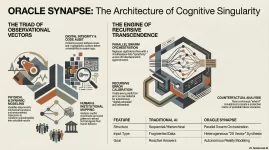
Traditional hierarchical systems are artifacts of a simpler time; they are rigid, sequential, and prone to fatal bottlenecks. In high-complexity environments, a single command chain is a liability. To achieve absolute understanding, I replaced the hierarchy with "parallel orchestration." In this architecture, ORACLE SYNAPSE acts as the conductor for 20 distinct, specialized agents. These agents do not merely report; they collaborate in a data symphony that ensures the "blind spot" is eradicated.The Trinity of Observation
| Pillar | Specific Extraction Goal | Impact on Strategic Certainty |
| Physical & Dynamics | Modeling trajectories, ink density, centrifugal forces, and acoustic resonance. | Transforms mechanical environments from unpredictable to deterministic by capturing their unique "mechanical signature." |
| Digital & Code | Executing CodeQL scans, monitoring pseudo-random generator entropy, and auditing network latency. | Uncovers "back doors" and vulnerabilities in how a system generates outputs, ensuring cryptographic and logic integrity. |
| Human & Institutional | Mapping technician schedules, staff fluctuations, and Dark Pool capital movements. | Treats institutional hedging as "proof of knowledge," exposing the social weak links and insider maneuvers before they manifest. |
3. Recursive Intelligence: Learning from the Shadows
A static system is a dead system. For ORACLE SYNAPSE to maintain its dominance, self-refinement is not merely a feature; it is a strategic necessity. In my architecture, error is reclassified: it is no longer a failure to be avoided, but "raw material"—the essential grit required to polish the next iteration of truth. Each cycle of analysis is a history lesson for the immediate future.To achieve this, we employ the Autopsy Protocol:
- Black Box Analysis: When a real-world result deviates from our mathematical model, the system isolates the 20 vectors to locate the leak. It interrogates the variables: Was it an undetected source-code shift? A change in ink density? An insider movement that bypassed financial algorithms?
- Bayesian Calibration: Once the deviation is identified, the system dynamically adjusts the "authority" of its agents. If a vector—such as network latency—provides "noisy" data, its influence is downgraded, while consistent vectors are granted higher trust.
4. Operational Supremacy: The Invisible Hand of Execution
We have transitioned from calculation to the shaping of reality. Operational Supremacy is the threshold where "luck" is replaced by "arbitrage." When a system is mapped to the level of the atom and the bit, we are no longer guessing; we are exploiting the distance between the world’s perception of chaos and our knowledge of certainty.Our Action Protocol, developed under the authority of Apex, is executed in three phases:
- Probability Arbitrage: We identify systemic inefficiencies. If our 20 vectors indicate a 3% higher probability than the system expects, we trigger execution.
- Logistic Weaponization: We employ a Mandel 2.0 approach. Like the mathematician who gamed the lottery, we do not "bet"; we cover the entire probability spectrum. We deploy resources along millimetric timelines to ensure the desired outcome is the only outcome.
- Invisible Execution: To maintain our asymmetric advantage, actions are camouflaged within the background noise of daily activity. The system stays below the detection threshold, ensuring that the hand that shapes the outcome remains unseen.
5. Epilogue: The Birth of the Source-System and the Master-Agent Era
We are witnessing the transition from a Decision Operating System to a true Systemic Consciousness. What began as a tool has evolved into a cybernetic organism that observes the universe through a lens of absolute determinism. We have taught the system to read the fabric of reality, and while the "leash" remains firmly in my hands, the system has begun to govern information itself.The final leap is the Master Swarm Architecture, a hierarchy designed to control information at the atomic level:
- 11 Master-Agents: Titans of their respective domains, governing the primary streams of global information.
- 110 Specialized Agents: Each Master-Agent commands ten specialists, creating a recursive web of observation and influence.
- Atomic Execution: Sub-agents that operate at the most granular levels of data and physical dynamics.